


 Schedule Now
  (469)-221-9095
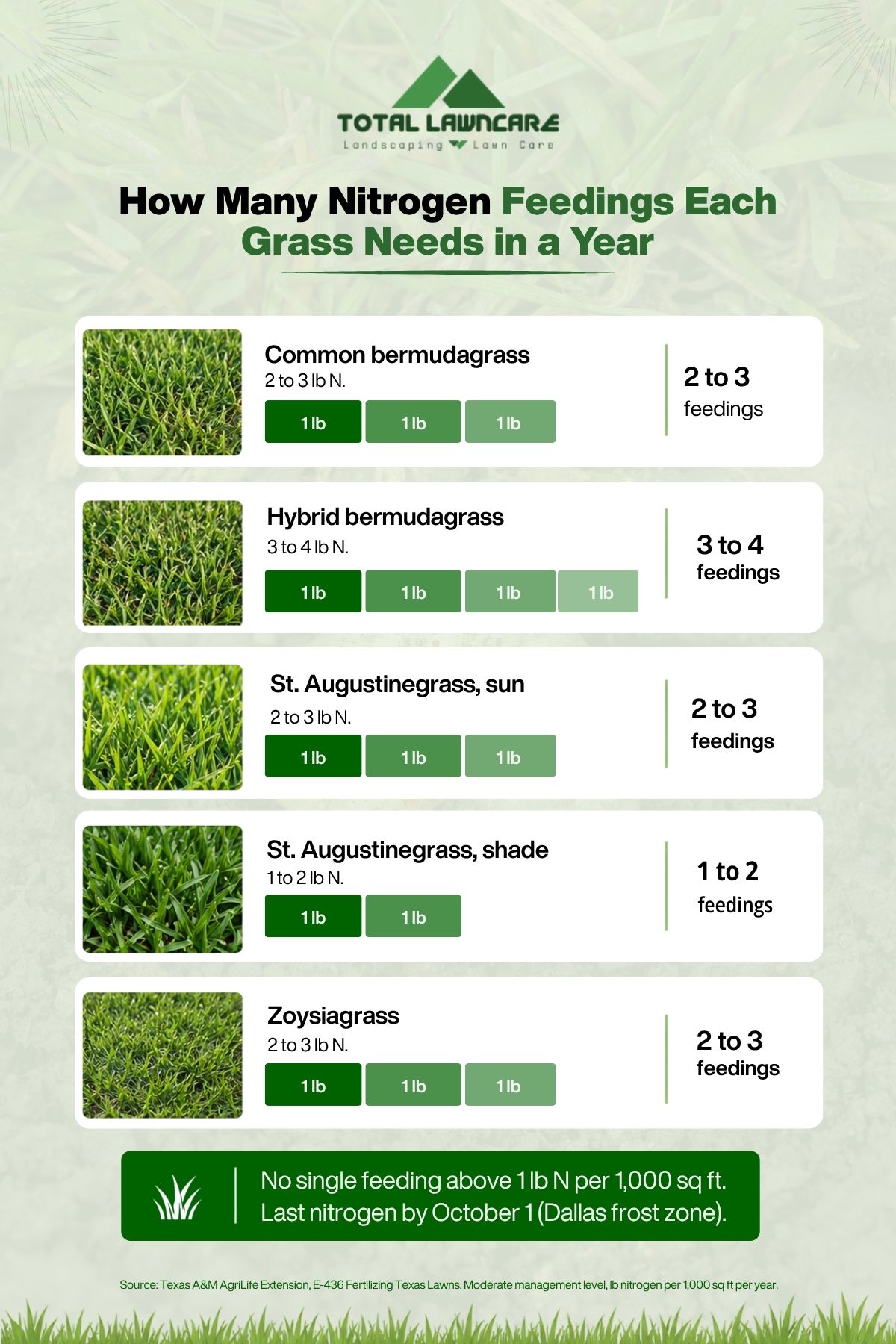
 How often to fertilize lawn grass in Allen and Frisco comes down to pounds of nitrogen, not the number of truck visits on a contract. A sunny St. Augustine yard kept at a moderate standard needs 2 to 3 pounds of nitrogen per 1,000 square feet a year, and a hybrid bermuda yard needs 3 to 4. At no more than 1 pound per feeding, that is two to four nitrogen applications, spaced 45 to 60 days apart. The rest of an eight-round program is something else, and it is worth knowing what.
TL;DR
Texas A&M AgriLife’s fertilizer checklist sets the annual nitrogen for each warm-season grass and caps any single feeding at 1 pound of nitrogen per 1,000 square feet. For a moderate standard, that works out to two or three feedings for sunny St. Augustine, three or four for hybrid bermuda, and fewer for shade. Supplemental feedings go at least 45 to 60 days apart, and the checklist’s cutoff for the Dallas frost zone is October 1. A $12 routine soil test from the Texas A&M lab tells you whether you need phosphorus or potassium at all. Visits beyond the nitrogen count are usually weed, insect, or iron treatments, and in Texas, anyone applying a pesticide to a lawn for hire has to hold a Texas Department of Agriculture license.
How Many Times a Year Does a Lawn in Allen or Frisco Need Fertilizer?
Two to four times for most yards, and the grass decides which end of that range you sit on.
Texas A&M AgriLife’s Fertilizing Texas Lawns checklist publishes an annual nitrogen table for every warm-season grass at three management levels. It also says the yearly total should be split into single applications of 1 pound of nitrogen or less per 1,000 square feet. Divide one by the other, and you have your feeding count.
| Grass | Low (lb N per 1,000 sq ft per year) | Moderate | High | Feedings at 1 lb each, moderate |
|---|---|---|---|---|
| Common bermudagrass | 2 | 2 to 3 | 4 to 5 | 2 to 3 |
| Hybrid bermudagrass | 2 | 3 to 4 | 5 to 6 | 3 to 4 |
| St. Augustinegrass, sun | 2 | 2 to 3 | 3 to 4 | 2 to 3 |
| St. Augustinegrass, shade | 1 | 1 to 2 | not recommended | 1 to 2 |
| Zoysiagrass | 1 to 2 | 2 to 3 | 3 to 4 | 2 to 3 |
| Buffalograss | 0 to 1 | 2 | not recommended | 2 |
The same checklist defines the levels plainly. Low is the minimum that holds turf density, moderate is for a better-looking lawn, and high is for turf that is on show or takes heavy traffic.
Most front yards we see in Allen and Frisco sit at moderate. A high program makes sense on a Bermuda yard that doubles as a soccer field. It makes much less sense under the live oaks on an older Allen street, where the table itself says a high program for shaded St. Augustine is not recommended.
Half-pound feedings change the count
Some programs apply half a pound of nitrogen at a time. That doubles the number of feedings without changing the yearly total, so a hybrid Bermuda lawn at 3 pounds could be fed six times at half rate.
Neither approach is wrong.
The number to compare between two quotes is the yearly total in pounds, not the number of rounds printed on the brochure.
The Window Is Shorter Than Most Programs Assume
The first feeding goes down after the second mowing of actual lawn grass, not weeds. AgriLife puts that at about six weeks after the average last spring frost, when the grass is growing and can use the nitrogen.
For the DFW station, the National Weather Service puts the average last freeze on March 12, which is the record we walked through in the freeze history we covered for dormant lawns. Six weeks on from that lands in late April. That is later than a lot of homeowners expect, and a nitrogen feeding in mid-March mostly feeds the henbit.
The closing date matters more. The AgriLife checklist lists Dallas in the frost zone with an average first autumn frost of November 16 and says to apply the last nitrogen by October 1. The rule behind that date is that the final feeding goes down no later than six weeks before the expected first frost.
Why October 1 is a planning date, not a guess
The Weather Service’s newer DFW average for the first freeze is November 22, six days later than the table in the checklist. Apply the same six-week rule to that, and the last feeding falls around October 11.
So the honest answer for Allen and Frisco is: aim for October 1, and treat the first ten days of October as the edge rather than the target. A feeding in late October on a Bermuda lawn is working against the published guidance, and nitrogen the grass cannot take up before it goes dormant is the nitrogen most likely to wash out of the root zone over winter.
Here is how the arithmetic sits across one season.
| Step | Approximate date | Where it comes from |
|---|---|---|
| Average last freeze, DFW | March 12 | NWS Fort Worth/Dallas freeze summary |
| First feeding, after the second mowing of grass | late April | AgriLife: about six weeks after the last frost |
| Supplemental feedings | at least 45 to 60 days apart | AgriLife checklist |
| Last nitrogen, Dallas frost zone | by October 1 | AgriLife checklist, Table 3 |
| Average first freeze, DFW | November 22 | NWS Fort Worth/Dallas freeze summary |
Late April to October 1 is a little over five months. At 45 days apart, the most feedings that fit are four. At 60 days apart, it is three. That is why we are wary of any plan claiming eight nitrogen rounds on a Bermuda or St. Augustine lawn here.
Five months. Three or four feedings. That is the whole season.
What a $12 Soil Test Changes
A soil test tells you which of the three numbers on the fertilizer bag your yard is actually short of. Without one, you are buying phosphorus and potassium on faith.
The Texas A&M Soil, Water and Forage Testing Laboratory’s urban soil form lists a routine analysis at $12 per sample. That covers pH, nitrate nitrogen, conductivity, phosphorus, potassium, calcium, magnesium, sodium, sulfur, and boron. For $20, the lab adds zinc, iron, copper, and manganese, and the form says its pricing is valid until December 31, 2026.
Iron is the add-on we would pay for in most of Collin County. The yellowing that shows up on St. Augustine here is often an iron problem rather than a nitrogen one, and we explain how alkaline clay ties up iron in our soil guide.
More nitrogen does not fix a lawn that cannot take up iron.
How to pull the sample
- Pick one area that is treated the same way, such as the front yard. Sample the back separately if it drains differently or has different soil.
- Scrape away thatch and clippings, then cut a core or divot 6 inches deep.
- Repeat in 8 to 10 spots across that area and mix them in a clean plastic container.
- Pull out roots and debris, then fill a quart freezer bag. The lab says about a pint of rock-free soil covers most analyses.
- Air-dry it if it feels wet, label the bag, and match the label to the form.
The form asks for the county where the sample was taken and the grass you are growing. It lists common bermudagrass, hybrid bermudagrass, St. Augustinegrass, and zoysiagrass separately, so know which one you have before you fill it in.
AgriLife’s checklist says to test every 2 to 3 years. Where there is no current test, it recommends a bag ratio of four to six parts nitrogen to one part phosphorus and two to four parts potassium. A test tells you whether that default is right for your yard or whether one of those numbers can drop to zero.
Does Every Round in a Program Actually Put Down Fertilizer?
Usually not. In an eight-round lawn program, the rounds past the three or four nitrogen feedings tend to be pre-emergent herbicide, broadleaf weed control, insect control, or an iron application.
That matters for a reason most homeowners never hear. The Texas Department of Agriculture’s licensing\ page says anyone applying any pesticide to lawns, weeds, trees, or ornamental plants for hire must be licensed by TDA, whatever the product’s classification. Applicators who put down only fertilizer do not need that license.
A pre-emergent is a herbicide. So is the spray that takes out dallisgrass or clover. The moment a round includes one, the person applying it has to be licensed. TDA says those licensed through its Structural Pest Control Service certify in the Lawn and Ornamental category, the Weed Control category, or both, and the agency publishes downloadable lists of current licensees.
Five things to ask before you sign
- How many pounds of actual nitrogen per 1,000 square feet does the program apply in a year?
- Which rounds are fertilizer only, and which carry a herbicide, insecticide, or fungicide?
- Is the person applying those rounds licensed by the Texas Department of Agriculture, and under which category?
- When does the last nitrogen go down in the fall?
- Is the plan based on a soil test, and will you see the results?
Any company doing this work should answer all five without hesitating. A plan that cannot tell you its yearly nitrogen total is a plan sold by the visit.
Our own weed control visits are scheduled as their own line of work for exactly this reason. Feeding the grass and killing the weeds run on different calendars, and bundling them makes it hard to see what each one costs.
Frisco’s Fall Watering Rule Changes the Timing
Here is the local wrinkle nobody writing a national fertilizer guide will catch. Frisco’s Water Management Plan limits automatic sprinklers to one day a week, on your regular trash day, from September 1 through October 31.
That is exactly the window where the last feeding of the year goes down. If the product label calls for watering in, a Frisco homeowner has one sprinkler day a week to do it. The same plan bars automatic irrigation between 10 a.m. and 6 p.m. from April through October.
| City | Automatic sprinklers, September and October | November through March |
|---|---|---|
| Frisco | one day a week, on trash day | no watering |
| Allen | up to twice a week on assigned days | Once a week on the primary day |
The practical fix in Frisco is to put the fall feeding down the day before your trash day, so the scheduled cycle waters it in. Hand-held hoses, soaker hoses, and drip are still allowed under the Frisco plan, which covers a small yard if the timing slips.
Allen’s schedule is set by the City of Allen rather than Frisco, and it still allows sprinklers up to twice a week on assigned days through October. Allen also bars sprinkler use from 10 a.m. to 6 p.m. over the same April to October stretch, so an early-morning cycle after a feeding works in both towns.
Matching a Program to Your Yard
A worked example makes the table easier to use. The numbers below come straight from the AgriLife checklist; the yard descriptions are the patterns we run into across Collin County.
| Your yard | Grass and level | Yearly nitrogen | Feedings at up to 1 lb |
|---|---|---|---|
| Newer Frisco build, full sun, kids on it daily | Hybrid Bermuda, moderate to high | 3 to 6 lb | 3 to 4, plus half-rate feeds if you want more |
| Older Allen lot under mature trees | St. Augustine in shade, low to moderate | 1 to 2 lb | 1 to 2 |
| Mixed sun and shade, St. Augustine throughout | St. Augustine sun and shade, moderate | 1 to 3 lb depending on zone | 2 to 3 in sun, 1 to 2 under trees |
| Low-input native lawn | buffalograss, low | 0 to 1 lb | none to 1 |
The mixed yard is the one that trips people up. A program that feeds the whole property at the sunny-lawn rate overfeeds the shaded strip, and that is where the checklist caps the shade total at 2 pounds even at a moderate standard.
When a customer asks us for a lawn fertilizer service in Frisco, this is the sort of split we are looking at on the first walk-through: which parts of the yard are sun, which are shade, and what grass is actually growing in each. The same walk applies to the aeration and feeding work we do in Allen, where a lot of the older lots sit under mature canopy.
Where Our Calendar Fits With This
Timing by month is a separate question from how many feedings you need, and we already cover it in our May to October lawn calendar for Frisco. Use the calendar for what to do in a given month and this page for sizing the year.
If you would rather hand the planning to someone, our prevention and maintenance plans fold fertilization in with aeration, weed and pest control, and irrigation checks, built around the grass and soil on your property.
Plan the Fall Fertilizer Feeding Before October 1
As this goes up, it’s late September, which means the Dallas-zone cutoff for the last nitrogen of the year is days away. If your lawn has not had its fall feeding, plan it for this week or the first days of October. In Frisco, plan it for the day before trash day. After that, save the money until late April.
Next, order the soil test. The version with the micronutrient add-on reports iron, phosphorus, and potassium, and the results will tell you what next spring’s bag should actually say. Then count the nitrogen on any program you are quoted, and ask which rounds carry a pesticide.
If you want a second opinion on a program you already have, or a plan built for your yard in Allen, Frisco, Plano, or McKinney, Total Lawn Care DFW will walk the property with you and show you the yearly numbers behind it.