


 Schedule Now
 (469)-221-9095
Whether to mulch or bag leaves on a Plano or Allen lawn comes down to how much grass you can still see. While about half the lawn shows through, run a mulching mower over dry leaves and let the pieces drop between the blades. Past that point, bag the overflow for your city’s weekly yard waste pickup. Whole leaves belong in the beds, never as a mat on the turf.
TL;DR
Mulch or bag leaves by coverage first, then by grass. A Texas A&M AgriLife Extension horticulturist calls mowing leaves into the lawn with a mulching mower the simplest use for them, and says it is easy on a coarse lawn such as St. Augustine. University of Minnesota Extension suggests mulching until only about half the lawn surface is visible, then bagging. In Allen, the weekly limit is 15 paper bags of leaves or grass clippings, and in Frisco it is 10 bags or bundles, paper only. Texas A&M Forest Service recommends keeping leaves in the yard while clearing them from the first five feet around the house. On the grass itself, shredded leaves are fine, and a matted layer of whole leaves is the thing to prevent.
Should You Mulch or Bag Leaves on a North Texas Lawn?
Mulch first, bag the overflow, and leave whole leaves only where no grass sits under them. That order follows what the state’s extension and forestry people publish, and it fits the warm-season lawns we look after in Plano, Allen, Frisco, and McKinney.
The quick version is a sorting job. Stand at the curb, look at the yard, and match what you see to a row.
| What you see | What to do | Who says so |
|---|---|---|
| About half the lawn or more still visible through the leaves | Mow them in with a mulching mower | Texas A&M AgriLife Extension, University of Minnesota Extension |
| Less than half the lawn visible | Mulch what the mower can hide, bag the rest | University of Minnesota Extension |
| Leaves lying in beds, under shrubs, around trees | Leave them, or shred and spread them as mulch | Texas A&M Forest Service, AgriLife |
| Leaves in gutters, in beds touching the house, against wood fences and decks | Remove them | Texas A&M Forest Service |
| Leaves on fine turf cut very low | Collect them | AgriLife |
Nothing in that table needs special equipment. It needs a look at the yard before the mower comes out, which is the step most people skip.
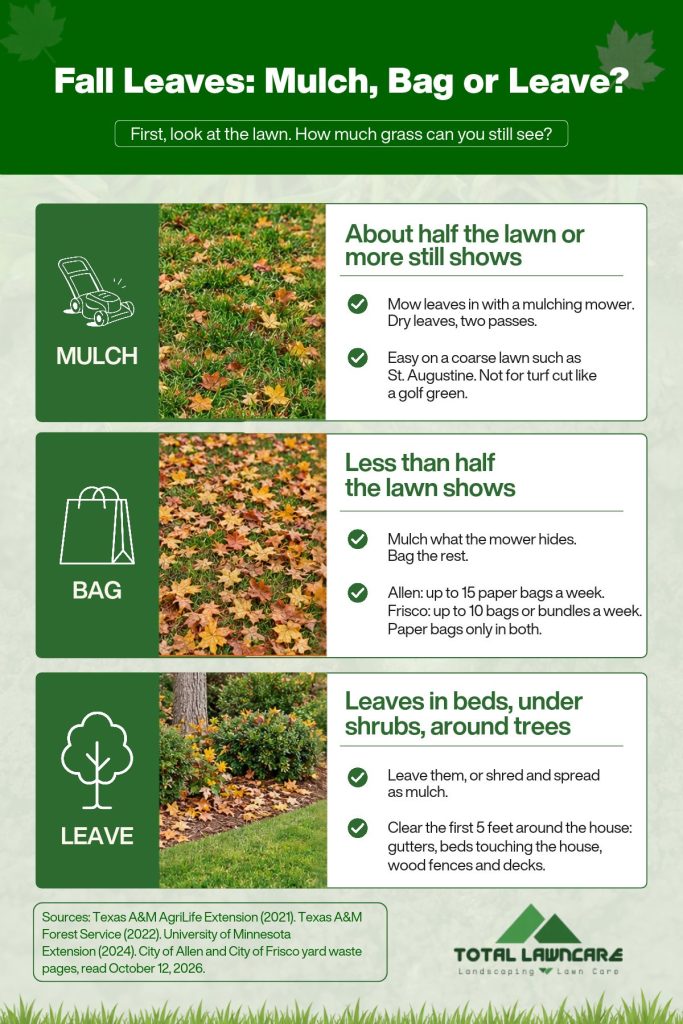
Mow Them In While Half the Lawn Still Shows
Skip Richter, an AgriLife horticulture agent, makes the case in Texas A&M AgriLife Extension’s three tips for recycling fall leaves, published in September 2021. He ranks mowing over leaves with a mulching mower as the simplest and easiest use for them. The pieces fall between the grass blades and release nutrients as they break down. His reasoning is hard to argue with: “It requires no extra work because you’re mowing anyway.”
How much is too much? No Texas A&M page we could open puts a number on it. University of Minnesota Extension does, in an October 2024 note titled Fall leaf mulching is good for your lawn. Its recommendation is to mulch tree leaves until only about half of the lawn surface is visible, and to start bagging once less than 50% of the lawn shows.
A caution on that figure. Minnesota’s own example of the harm is snow mold damage, so the advice was written for lawns that spend winter under snow. Treat the half-visible mark as a working rule of thumb for a Collin County yard, and let your eyes overrule it after the first pass.
Five habits that make mulching work
- Wait for dry leaves. The Minnesota note says to mulch regularly when leaves are dry, and AgriLife’s mowing guide for warm-season lawns warns that damp material clumps instead of spreading evenly.
- Go early and go often. Texas A&M Forest Service advises mulching soon after leaves fall. A thin layer every week is easier on the mower and the grass than one thick layer in December.
- Make a second pass. Minnesota recommends a double pass for a finer mulch that breaks down faster.
- Look down afterward. If shredded pieces are sitting on top of the grass as a layer, the mower has reached its limit and the surplus goes in a bag.
- Clear the hard surfaces. The AgriLife mowing guide says to sweep or blow clippings off streets and sidewalks and back into the turf, and leaf fragments deserve the same treatment.
One thing mulched leaves do not do is replace fertilizer. The Minnesota note is careful here: mulched leaves return nitrogen, potassium and phosphorus, but less nitrogen than grass clippings do. They trim what the lawn needs without covering it, and the count itself is in our piece on how many nitrogen feedings each grass needs.
What the grass type changes
Richter draws the line by texture. A coarse St. Augustine lawn takes mowed leaves easily, he says, and a golf course green could not take them at all. Home lawns in Plano and Allen sit between those two ends, and mowing height is a fair way to place yours.
The heights below come from Texas A&M AgriLife’s publication Mowing Recommendations for Warm-Season Turfgrass Lawns (SCSC-PU-178, May 2022). The last column is our read of what each height means for leaves. It is not AgriLife’s wording, apart from the St. Augustine row.
| Grass | AgriLife height of cut, rotary mower | What that means for mowing leaves in |
|---|---|---|
| St. Augustine grass | 2.5 to 5 inches | The easy case. A tall, coarse canopy hides shredded leaf well |
| Common bermudagrass | 1.5 to 4 inches | Works well when kept toward the taller end |
| Coarse zoysiagrass | 1.5 to 4 inches | Much the same as common bermuda |
| Hybrid bermudagrass | 1.5 to 2.5 inches | Less canopy to hide the pieces. Thinner layers, more passes |
| Fine zoysiagrass | 1.5 to 2 inches | Treat it like hybrid bermuda |
The same guide recommends raising the mowing height in fall so the grass can store energy before it goes dormant. That advice happens to help with leaves too. A slightly taller lawn swallows more shredded material than one kept at its summer low.
Lawns cut with a reel mower below 1.5 inches are the nearest thing a neighborhood has to Richter’s golf green. On those, we would collect the leaves and use them somewhere else.
When Does Bagging Become the Right Call?
Bagging is right when the mower can no longer make the leaves disappear. Less than half the lawn visible is the Minnesota mark, and shredded leaf still lying on top of the grass after two passes says the same thing. Coverage aside, a few situations call for a bag every time.
- Weeds that have gone to seed in that patch. AgriLife’s mowing guide says clippings carrying weed seed heads should be collected, bagged, and removed so they do not spread across the lawn. Leaves raked up from the same spot go with them.
- An area with a known disease or insect problem. The guide suggests bagging and removing clippings from it until the problem is resolved.
- Wet, heavy leaves. Damp material clumps, and the guide warns that rows or piles left on the lawn can damage the turf underneath by restricting sunlight and water.
- Fine turf cut very low, where there is no canopy to hide anything.
Bagging here does not mean the landfill. Frisco says the yard waste from its curbside program is turned into mulch and compost. Allen takes leaves in biodegradable paper bags only and does not allow nylon rope or other non-compostable ties on bundles.
Richter’s view is that community collection of green waste is better than throwing it away, yet still not the simplest or most economical use of leaves. We agree with the ranking. Bag what the lawn and the beds cannot use, and not before.
What Plano, Allen and Frisco Take at the Curb
Each city sets its own limits, and they differ more than neighbors assume. We read the pages below on October 12, 2026, and the table repeats only what each page said that day.
| Allen | Frisco | |
|---|---|---|
| Hauler named by the city | Community Waste Disposal (CWD) | Waste Connections |
| Pickup | Weekly, on your assigned trash day | Once a week, same day as recycling and trash |
| Weekly limit | Up to 15 paper bags of leaves or grass clippings, and up to 7 bundles of sticks or brush | Up to 10 bags or bundles |
| Bags | Biodegradable paper lawn bags only. Plastic bags are not collected | Paper bags. Plastic bags are not accepted |
| Bundles | 4 feet by 2 feet, under 40 pounds, tied with cotton or jute rope, twine or string | Limbs cut to 3-foot lengths, tied with compostable rope or twine, 30 pounds at most |
| Set out | By 7 a.m., at least 2 feet from trash and recycling carts | By 7 a.m., 3 feet from your carts |
| Not accepted | Dirt, gravel, concrete, rock, sod | Dirt and mulch |
The sources are Allen’s yard waste page and Frisco’s residential yard waste page. Frisco’s page gives the cart distance as two to three feet in one line and three feet in another, so we printed the larger figure.
Why Plano is not in the table
Plano publishes its bag and bundle rules on Plano’s yard trimmings page under a tab called Yard Trimmings Collection Guidelines, next to a second tab for a special paid yard trimmings collection. The page describes yard trimmings as organic material such as grass clippings and leaves, and says treated wood does not count.
The guideline panel itself would not load for us on the day we checked. A limit printed from memory is worse than no limit, so we are leaving Plano’s numbers out. Read them on the city’s page before you buy bags. The same goes for McKinney, where we also work: take the limits from the city’s own solid waste page.
The detail that catches Frisco homeowners
Allen counts bags and bundles separately, 15 of one and 7 of the other. Frisco’s 10 covers bags and bundles together. In our experience, a yard with a couple of mature shade trees can outrun ten bags in a single weekend, which is one more reason to mulch first and bag what is left. It matters most on the Frisco lawns we service, where a pile of pruned limbs and a row of leaf bags compete for the same ten slots.
Allen adds a line worth reading twice. Its page says the city is not responsible for removing debris from commercial contractors, and that a contractor hired to trim or remove trees must handle all of the debris. Before anyone starts work on an Allen lawn we maintain, or on any other, the question to ask is where the leaves and limbs go when the crew leaves. Ask us, too.
Is It Ever Fine to Leave the Leaves Where They Fall?
Yes, in beds, under shrubs, and around trees. No, on the lawn once they form a layer. Texas A&M Forest Service goes further than most homeowners expect: in its guidance on what to do with fallen leaves, its urban forester recommends leaving leaves where they are because that copies a forest floor.
The agency gives three reasons. Soil in urban areas tends to be compacted and short on organic material, and decomposing leaves put it back. A leaf layer insulates the roots of trees and plants from cold. Leaves also shelter the insects that overwinter in them, a point AgriLife repeated in its November 2024 gardening guide, which asks gardeners to keep some leaf piles for pollinators and beneficial insects.
The exception is firm. Embers are the leading cause of homes destroyed by wildfire, the Forest Service says, and embers collect where leaves do. Its Firewise coordinator wants leaves cleared from the first five feet around a home.
- Gutters
- Planting beds that touch the house
- The base of wooden fences
- The edges of wooden decks
That is a short list, and every item on it is somewhere a mower never reaches.
Two Pieces of Advice That Only Sound Opposed
Our own guide to a dormant North Texas lawn tells you to keep leaves off the turf, because a wet mat holds moisture against the crown. The Forest Service tells you to leave the leaves. Both are right, about different things.
The difference is shredded against matted, and lawn against bed. Minnesota’s extension service warns that excessive leaf litter left on the surface can harm a lawn by spring. AgriLife’s mowing guide says the same of piled clippings. Neither objects to fine pieces sifted down between the blades.
Whole leaves stay in the beds. On the grass, they get shredded. Whatever still lies in a layer gets moved.
What Else a Fall Cleanup Has to Cover
The lawn is the last stop on a fall cleanup, not the first. Working from the house outward keeps you from blowing leaves onto grass you have already finished.
- Roof edge and gutters first. These sit inside the five-foot band the Forest Service wants cleared.
- Fence lines and deck edges next. Leaves gather against wood, which is exactly where the agency says not to keep them.
- Beds after that, where a shredded layer stays as mulch. Richter notes that leaf mulch cuts evaporation and weed problems, and that running a mower over the leaves a few times makes them look neater and less likely to blow away.
- The driveway, the sidewalk, and the street gutter. AgriLife’s mowing guide warns that grass clippings washed into storm drains add to nutrient pollution in surface water, which is a good reason not to blow leaves into the street either.
- The lawn itself, mulched or bagged by the table at the top of this page.
Plan on doing this more than once. The Forest Service’s article is dated December 4, 2022, and opens by noting that leaves were still falling across the state. It also says that keeping leaves in the yard means some work through the winter to stop windblown piles from building up around the house.
Some yards are past the point where a mower and a Saturday will fix them. That is the job our yard maintenance and cleanup service exists for. It covers leaf removal, pruning, debris removal and seasonal preparation, along with routine mowing and edging. Seasonal clean-up is also part of our residential lawn care work for homeowners who would sooner not think about it each week.
Sort Your Leaves Before the Next Trash Day
Start with a look. If half the grass still shows, mow the leaves in this week while they are dry, and make a second pass. If it does not, mulch what the mower will hide and bag the rest.
Pull up your city’s page and note the weekly limit before you fill a single bag. Allen and Frisco are in the table above, and Plano’s rules are on its yard trimmings page. Buy paper bags, not plastic, in Allen and Frisco.
Clear the gutters and the beds against the house, and keep the rest of the bed leaves where they are. If you would like the whole job handled, including on the Plano yards on our schedule, Total Lawn Care DFW does leaf removal and seasonal cleanup across Plano, Allen, Frisco, and McKinney. Request a free quote through our site and tell us which of the three piles your yard is in.