


 Schedule Now
  (469)-221-9095
 TL;DR
Dallas sits on a mix of black clay, sandy loam, and rocky limestone-based soils. The dominant type is dense clay that holds water on top, drains poorly, and cracks in summer heat. Knowing your soil type tells you exactly which grass to plant, how to water, and what fertilizer your lawn actually needs.
Most homeowners in Dallas blame the weather when their yard looks rough. Too much heat, too little rain, the August sun frying everything brown. The weather definitely doesn’t help, but the bigger issue is usually right under your feet. Soil types in Dallas vary a lot depending on which part of the metro you live in, and the kind of dirt you’re working with controls almost everything about how your lawn behaves. Drainage, fertilizer needs, root depth, watering schedule, and even which grass species will actually survive. If you’ve been pouring water and money into a yard that still looks tired, the soil is probably the reason — especially when it comes to proper lawn care in Dallas conditions.
We’ve worked on lawns from Highland Park to Mesquite to Frisco to Cedar Hill, and the soil shifts noticeably as you move across the metro. Knowing what you’re dealing with is step one of fixing it.
Why Soil is Important
A lawn lives and dies by what’s underneath it. Healthy soil holds the right amount of water, drains the rest, gives roots room to grow, and feeds the grass with nutrients and oxygen. Bad soil does the opposite. It either holds too much water and suffocates roots or holds too little and lets the grass dry out within a day. It compacts so hard that nothing can grow into it. It locks up nutrients, so even fertilizer doesn’t help.
You can do everything else right and still have a struggling lawn if your soil is fighting you. You can also do almost nothing else and have a great lawn if your soil is cooperating. That’s how much it matters.
The Three Main Soil Types in Dallas
Dallas County and the surrounding metro sit on three main types of soil, depending on geography. Knowing which one you have is the first thing to figure out before you spend another dollar on lawn care.
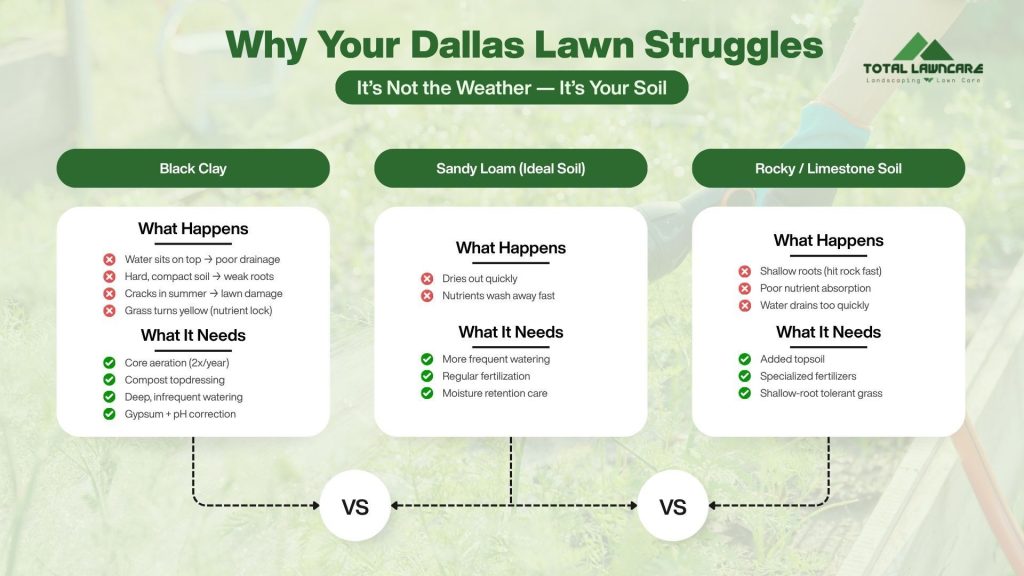
Black Clay (Houston Black and Similar Series)
This is the soil most Dallas homeowners are dealing with. Black clay covers a huge portion of the metro and stretches across much of North Texas. It’s dark, dense, and famous for one thing: it expands when wet and shrinks when dry. That expansion and contraction is what causes foundation problems all over the area, and it affects your lawn just as much as it affects your house.
Black clay holds water like a sponge on the surface, but doesn’t let it drain through quickly. After heavy rain, you get standing water and soggy roots. In summer, it dries out, cracks open in big jagged splits, and pulls away from anything planted in it. The clay is also very alkaline, which locks up certain nutrients and changes which fertilizers actually work.
Lawns on black clay struggle with compaction, poor drainage, and stressed root systems. Common problems include yellowing grass, fungal disease in wet weather, and dead patches in dry weather.
Sandy Loam
Some areas of Dallas, particularly in the southern parts of the metro and parts of the western fringe, have sandy loam soil. This is a much friendlier soil for most lawns. It drains well, allows roots to grow deeply, and accepts fertilizer better than clay does. The downside is that sandy soil dries out fast and doesn’t hold nutrients as long, so you need to water and feed more often.
If you live in an area with sandy loam, count yourself lucky. The lawn care work is easier, the grass roots go deeper, and you have fewer drainage and disease issues to fight.
Rocky Limestone-Based Soil
Parts of Dallas, especially in the Cedar Hill, Grand Prairie, and parts of the Plano area, sit on rocky limestone-based soils. These are shallow and well-drained, but they have very limited topsoil and are highly alkaline. Roots have a hard time growing deep because they hit limestone within a few inches in some areas. Drainage is fast because water just runs off the rock, but nutrient availability is poor, and fertilizer choices matter.
Lawns on rocky soils often need imported topsoil, deeper bed prep, and grass species that can handle shallow root zones.
How to Find Which Soil You Have
You can do a basic soil test yourself in about 10 minutes. Take a small handful of moist soil from a few inches below the surface. Squeeze it in your fist and observe what happens.
- If it forms a ball that holds its shape and feels sticky, you’ve got clay
- If it crumbles apart when you open your hand, you’ve got sand or loam
- If it feels slippery and smooth like modeling clay, you’ve got heavy clay
- If you can’t even get a sample because the ground is full of rocks, you’ve got a limestone-based soil
For a real answer, send a soil sample to the Texas A&M AgriLife Extension Service. They run inexpensive soil tests that tell you the exact pH, nutrient profile, and texture of your soil. The information is worth the small fee because it lets you stop guessing and start treating the actual problem.
Why Black Clay Is the Hardest to Manage
Since most Dallas homeowners are dealing with black clay, it deserves a closer look. Here’s what makes it such a challenge for lawns:
- It compacts easily, especially when walked on or driven over while wet.
- It doesn’t allow roots to penetrate deeply.
- Water either runs off the surface or pools on top.
- It dries out and cracks during summer drought.
- Cracks pull on root systems and damage them.
- The alkaline pH locks up iron, which is why so many lawns turn yellow.
- Aerating it is harder than aerating other soil types.
- Heavy rain creates anaerobic conditions that suffocate roots and feed fungal disease.
If any of those sound familiar, you’re not imagining things. Black clay is genuinely tough.
What Grass Actually Grows Well in Dallas Soil
Not every grass species can handle Dallas soil. The ones that work for most local lawns include:
Bermuda grass: The most common Dallas lawn grass. It loves heat, tolerates clay if drainage is decent, and recovers well from drought. It needs full sun and doesn’t do well in shade.
St. Augustine grass: Better for shaded yards. Handles clay reasonably well but needs more water than Bermuda. Vulnerable to chinch bugs and some fungal diseases.
Zoysia grass: A premium option that handles a range of soils. Slower to establish but tough once it takes hold. Tolerates clay and drought well.
Buffalo grass: A native grass for low-maintenance yards. Very drought-tolerant. Handles alkaline soil well. Doesn’t take heavy foot traffic as well as Bermuda.
Avoid cool-season grasses like fescue or Kentucky bluegrass. They struggle in the Dallas heat and clay.
Fixing Bad Soil Instead of Fighting It
You can’t change the underlying geology of your yard, but you can improve the top 6 to 12 inches significantly. The goal isn’t to replace the clay; it’s to break it up, add organic matter, and improve drainage and root depth. Here’s a basic plan that works for most clay-soil yards:
- Core aerate twice a year, once in spring and once in fall.
- Topdress with a thin layer of compost after each aeration.
- Apply gypsum to help break up compacted clay over time.
- Use slow-release organic fertilizers that build soil biology.
- Adjust pH with sulfur if soil testing shows it’s too alkaline.
- Avoid walking on the lawn when the soil is wet to prevent compaction.
- Mow at the proper height for your grass species to encourage deep roots.
- Water deeply and infrequently to train roots downward.
Start with the right foundation through yard maintenance and cleanup services, which help prepare and reset the soil conditions before deeper improvement work begins.
Doing this consistently for 2 to 3 years can transform a struggling lawn on bad soil into a healthy lawn that looks normal and behaves well. It’s not instant, but it’s permanent if you keep it up.
The Watering Mistake Almost Everyone in Dallas Makes
The most common mistake we see on Dallas clay lawns is overwatering. People assume that because Texas is hot, the lawn needs daily watering. On clay soil, daily watering is one of the worst things you can do. The clay holds water for a long time, so daily watering keeps the surface saturated, suffocates roots, encourages disease, and trains the grass to develop shallow roots that can’t survive a week without irrigation.
The right pattern for clay soils is deep, infrequent watering. Once or twice a week, with enough water to soak down 4 to 6 inches each time. This forces roots to grow downward, chasing the moisture, builds drought resilience, and prevents the surface from staying soaked.
Wrapping Up
The dirt under your lawn isn’t going anywhere, but it doesn’t have to be the boss either. Once you understand what kind of soil you’ve got, you can stop fighting it and start working with it. Pick the right grass, water the right way, fix the parts you can fix, and the difference shows up faster than you’d expect. A lawn on improved Dallas clay can absolutely look great. It just takes the right knowledge and a little patience.
When you’d rather have someone else handle the work, we’re happy to take a look at your yard, figure out what soil you’re working with, and put together a plan that actually fits your conditions. At Total Lawn Care, we’ve handled lawns across every kind of Dallas dirt, and we’ll always tell you straight what your yard needs and what it doesn’t. Give us a call when you’re ready.