


 Schedule Now
  (469)-221-9095
 Most of the time, a Texas lawn turns brown for one of three reasons: it is thirsty, it has a fungal disease, or grubs are chewing the roots. Drought stress shows up as a wide, even fade across the whole yard, usually in the hottest stretch of summer. Disease tends to make round patches with odd edges, often after warm, wet, humid spells. Grubs leave brown areas that peel up like loose carpet because the roots are gone. There are a few other culprits, too, like dull mower blades, dog spots, fertilizer burn, or grass simply going dormant in winter. The fastest way to tell them apart is the tug test and a look at the pattern. Pull on a brown patch. If it lifts easily, think grubs. If the soil is dry and crumbly, think water. If it stays rooted but spotty, think disease. Lawn care services can help diagnose the problem and recommend the right treatment.
Is My Brown Grass Dead or Just Stressed?
Brown grass is often stressed or dormant, not dead, and that distinction changes everything. Healthy Texas grasses like Bermuda and St. Augustine go tan or straw colored on purpose to protect themselves during heat, drought, or cold. Dead grass does not come back, no matter what you do. Stressed grass perks up once you fix the cause.
Here is the simple check. Grab a handful of the brown blades and tug. Dormant or stressed grass holds firm, and the crown near the soil still looks pale green or white and feels slightly springy.
Dead grass pulls out with no resistance, and the crown is brown and brittle all the way down. You can also water a small test area deeply for a week. If green starts creeping back in, the lawn was just stressed. If nothing changes, that section likely needs reseeding or sod.
This matters because people often rip out a lawn that would have recovered on its own with a couple of good soakings. Across the Dallas-Fort Worth area, summer browning is frequently temporary, so slow down before you assume the worst. A good rule of thumb: a Bermuda lawn can sit dormant and brown for four to six weeks during a hard drought and still bounce back once the rain returns or you water deeply. St. Augustine is less forgiving and tends to thin out faster when it goes dry, so it pays to act sooner on that grass type. The crown test is your best friend here, because the crown is the growing point that stays alive even when every blade above it has turned the color of straw.
What Are the Top Causes of a Brown Lawn in Texas?
The top causes break down into a short list, and knowing them helps you skip straight to the likely answer. Run through these before you spend money on treatments:
- Drought and heat. Our summers run hot and dry, and grass fades fast when it does not get enough deep water.
- Fungal disease. Warm nights plus humidity or overwatering feed lawn fungus, the most common being a circular blight.
- Grubs and other pests. White grubs eat roots from below, and chinch bugs suck the life out of sunny St. Augustine spots.
- Dull mower blades. Torn grass tips dry out and turn the whole yard a hazy brown.
- Dog urine. Small, dark green rings around bright brown centers usually point here.
- Fertilizer or chemical burn. Too much product or a spill leaves sharp brown streaks.
- Compacted soil and thatch. Water and air cannot reach the roots, so the grass starves.
- Winter dormancy. Bermuda goes fully tan after the first hard frost, which is normal.
When a lawn turning brown in Texas has you stumped, start with this list and the pattern of the damage. The shape and timing of the brown almost always narrow it down to one or two causes. Timing alone tells you a lot in our area.
Browning that starts in late June or July, when the heat settles in and rain stops, points hard at drought. Browning that flare right after a warm, rainy stretch in late spring or early fall points to fungus. Spongy brown spots that show up out of nowhere in late summer, often with birds working the lawn at dawn, point at grubs hatching and feeding. Damage that appears in straight lines or sharp blocks usually traces back to something human, like a fertilizer spreader left running too long or a chemical spill.
How Do I Tell Drought From Disease From Grubs?
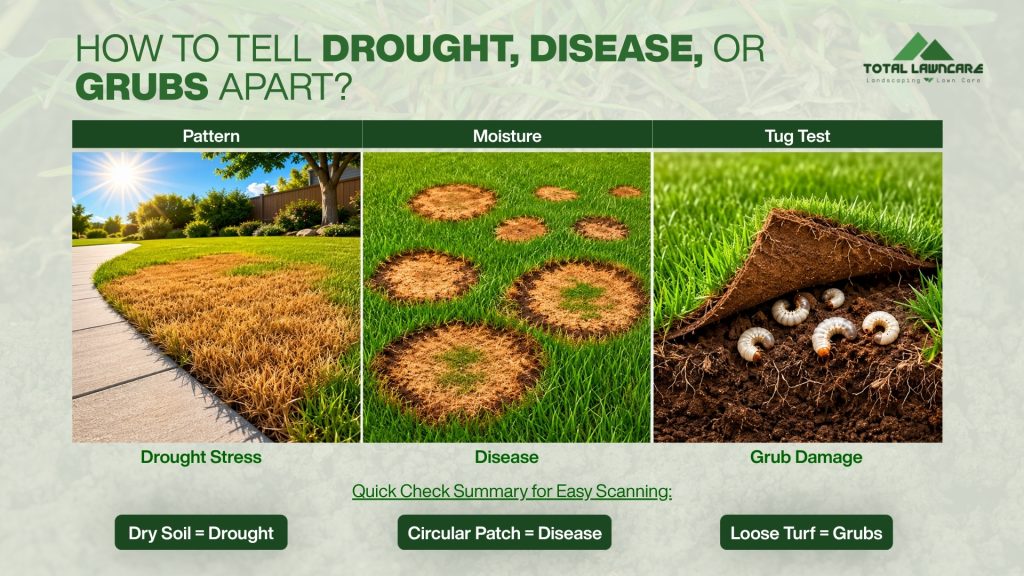
You tell them apart by looking at three things: the pattern, the moisture, and what happens when you tug. Each cause leaves a different fingerprint, so a few minutes in the yard usually settles it.
Drought stress
Lawn drought stress shows up as a broad, even browning, worst in sunny spots, along sidewalks, and on slopes where water runs off. Footprints stay pressed into the grass instead of springing back, and the blades fold or curl. The soil under a brown patch is dry, hard, and dusty.
This is the most common reason yards fade in July and August around DFW. The good news is it is also the easiest to fix. Watch the edges near concrete first, because driveways and walkways soak up heat all day and bake the soil right beside them. Those strips of grass turn the fastest and tell you the rest of the yard is not far behind.
Disease
A brown patch lawn problem usually appears as roughly circular patches a few inches to several feet across, sometimes with a darker ring around the edge or a green center, like a doughnut. It tends to flare after warm, muggy weather or heavy watering, especially in St. Augustine. The grass stays rooted when you pull it, but blades may look slimy or rotted near the base. Mornings with heavy dew make it worse. If you tug a blade and it slips out of the sheath with a soft, dark, rotten spot at the bottom, that is the signature of brown patch fungus rather than dry soil.
Grubs
Grub damage leaves irregular brown areas that feel spongy underfoot, and the turf rolls back like loose sod because the roots have been eaten. Pull on it. If it lifts with almost no resistance, peel it back and look in the top inch or two of soil.
White, C-shaped larvae the size of a pea or larger confirm it. You may also notice birds, skunks, or armadillos tearing up the lawn to feed on them. A few grubs in a square foot is normal and nothing to worry about. The threshold where you should treat is roughly five or more per square foot, since that is when their feeding outpaces the grass’s ability to regrow roots.
How Do I Test Which One It Is?
You test with three quick hands-on checks that take ten minutes and no special tools. Do them in the brown area and a healthy area so you can compare:
- The tug and peel test. Grab the brown grass and pull up. Easy lift with exposed soil and no roots means grubs. Firm and rooted points away from grubs and toward water or disease:
- The screwdriver test. Push a long screwdriver into the brown spot, then into a green spot. If it slides into the green area but stops short in the brown one, the soil is dry or compacted, which leans toward drought stress or compaction.
- The pattern and timing check. Even and widespread in peak heat says drought. Round patches after wet, humid weather say fungus. Spongy, peeling, irregular spots with insects below, say pests.
If you still are not sure, dig a small square about a foot wide and a couple of inches deep at the edge where brown meets green. That edge is where you see active grubs, root damage, or dry soil most clearly. A fourth quick test that catches a lot of people: check your sprinkler coverage by setting out a few empty tuna cans across the yard and running the system for fifteen minutes. If some cans hold a quarter inch and others are nearly dry, you have uneven coverage, and the dry-can zones are exactly where the brown will show up. A clogged nozzle or a head blocked by tall grass causes more browning than most homeowners expect.
What Is the Fix for Each Cause?
The fix depends entirely on which cause you confirmed, so match the solution to your diagnosis rather than guessing. Here is what works for each of the common ones in our climate.
Fixing drought stress
Water deeply and less often. Aim for about one inch of water per week total, delivered in one or two longer soakings rather than daily sprinkles. Deep watering pushes roots down where the soil stays cooler. Water early in the morning so blades dry before night.
Raise your mower height during summer so taller grass shades its own roots and holds moisture. Most stressed lawns green back up within a week or two of better watering. A practical trick for measuring one inch: most DFW yards need about thirty to forty minutes per zone with standard spray heads, but rotor heads throw less water and may need twice that. The tuna-can test settles it for your specific system. During a watering restriction, prioritize the soakings on cooler mornings and let the rest of the yard ride out the heat, since a dormant Bermuda lawn will recover faster than you think once conditions ease.
Fixing disease
Stop overwatering first, because fungus thrives on wet leaves. Water only in the early morning, never in the evening. Improve airflow by mowing at the right height with a sharp blade and bagging clippings while the disease is active, so you do not spread spores.
A fungicide labeled for your grass type can help, but timing and the right product matter. If patches keep spreading after you dry things out, it is worth getting a trained set of eyes on it. One thing many homeowners miss: cutting back on nitrogen fertilizer during an active outbreak. A flush of quick-release nitrogen feeds the fungus along with the grass and can make brown patch spread faster, so hold off on heavy feeding until the lawn is dry and recovering.
Fixing grubs
If you confirmed several grubs per square foot, a targeted grub control product applied at the right time of year is the answer. Timing is everything with grubs, since the young larvae are far easier to knock back than mature ones. In our area, preventive products work best when put down in late spring to early summer, before eggs hatch, while curative products are the move once you actually see damage in late summer. After treatment, water and feed the lawn so it can rebuild the roots that were eaten. Badly damaged spots may need reseeding or sod once the grubs are gone.
Fixing the smaller causes
Sharpen or replace mower blades so cuts are clean. A good habit is sharpening at least once a season, or more if you mow a large yard, since a dull blade tears rather than slices and leaves a frayed, brown-tipped look across the whole lawn. Dilute dog spots with a deep watering and rinse, and consider training pets to one mulched corner of the yard.
Avoid over-applying fertilizer, and water it in well so the salts do not sit and burn the blades. For compacted soil and heavy thatch, aeration opens things up so water and air reach the roots again, and early fall or spring is the best window for it here. If your whole Bermuda lawn went tan in December, do nothing. It will green up on its own in spring.
For pest and treatment work specifically, our residential lawn care and treatment services page covers how we handle grubs, fungus, and the feeding schedule that keeps turf thick enough to resist all three.
When Should I Call for Treatment?
Call for treatment when the brown is spreading fast, when you confirm grubs or active disease, or when basic watering changes do not bring color back within two weeks. Some problems get worse quietly. A grub population that goes untreated one season often returns larger the next, and a fungus that spreads through wet weather can take out big sections before you notice.
It is also worth a call when you simply cannot tell which cause you are dealing with, since the wrong fix wastes money and time. Spraying fungicide on a grub problem does nothing, and dumping water on a fungus makes it worse. A trained eye reads the pattern, checks the soil, and matches the treatment to the actual cause. Homeowners across Plano, Frisco, and Allen deal with the same heat, soil, and pest pressure, so a local crew that treats these yards every week already knows the seasonal patterns. The clay-heavy soil common across much of DFW also drains slowly and compacts hard, which feeds both fungus and drought-like browning at the same time, so a yard can show two problems at once. You can see how we handle ongoing care in specific cities like Plano lawn care, Frisco lawn care, and Allen lawn care.
Get your Green Back this Season
If your yard is fading and you would rather not gamble on the wrong fix, we are happy to take a look and tell you exactly what is going on. I have walked plenty of brown DFW lawns back to green by matching the treatment to the real cause instead of guessing. Reach out through Total Lawn Care DFW, and we will sort out whether you are dealing with water, fungus, or grubs, then handle it.