


 Schedule Now
  (469)-221-9095
 In Frisco during peak summer, weekly mowing costs less per visit (roughly $40 to $55 for a typical lot) but more per month, while biweekly runs about 20 to 30 percent more per visit because the crew fights taller, tougher grass. Weekly wins from May through September because Bermuda and St. Augustine grow fast in our heat, and skipping a week forces the crew to break the one-third rule, which scalps the lawn and opens the door to brown patch. Biweekly can work in spring and fall when growth slows. Below we break down the real math, the grass biology behind it, and when each cadence actually makes sense on a Frisco lawn.
Here’s What Most Frisco Homeowners Get Wrong About Mowing Frequency
Most people pick a mowing cadence based on their budget, then assume the grass will cooperate. In a Frisco lawn care July, it won’t. Warm-season turf sets the schedule, not your calendar, and the moment you stretch a cut too far, you pay for it twice: once in a rougher, more expensive visit, and again in a stressed lawn that takes weeks to recover. This guide walks through what weekly and biweekly service actually cost here, the one-third rule that decides which is safe, how Bermuda and St. Augustine behave differently in our summer heat, and the handful of situations where biweekly is genuinely the smarter call.
What Weekly vs. biweekly mowing costs in Frisco
Here are the honest local ranges we see on typical Frisco residential lots (roughly 6,000 to 10,000 square feet of turf) in 2026. Treat these as ranges, not quotes, since lot size, slope, trees, and edging all move the number.
| Cadence | Per visit (typical Frisco lot) | Rough monthly (peak season) | What you actually get |
| Weekly | $40 to $55 | $160 to $220 (4 to 5 visits) | Shorter grass, faster cut, crisp edges every week |
| Biweekly | $50 to $70 | $100 to $140 (2 to 3 visits) | Longer grass, slower cut, more cleanup |
Notice the flip. Weekly costs less per visit but more per month. Biweekly saves money monthly because you buy half as many cuts, yet each of those cuts costs more. The reason is simple: two weeks of Frisco summer growth means taller, denser grass that takes longer to cut, dulls blades faster, and leaves heavy clumps a crew has to bag or double-cut.
That per-visit premium is real. When we quote biweekly on lawn mowing for jobs in June, the visit price runs 20 to 30 percent above the weekly rate for the same yard, because the labor and wear are genuinely higher. Anyone quoting biweekly at the same per-cut price as weekly is either underestimating the work or planning to rush it.
Why can the same yard cost two different amounts
Two neighbors with identical lots can pay very different prices, and cadence is a big reason. A weekly lawn stays in an easy-to-cut window, so the crew is in and out. A biweekly lawn in peak growth is a bigger job every single time, so the fair price is higher. Add-ons like heavy edging, bagging, or a badly overgrown first cut push it further.
The One-Third Rule: Why Weekly Wins In Peak Growth
The one-third rule is a piece of turf science that settles the weekly vs biweekly question in summer. The rule: never remove more than one-third of the grass blade’s height in a single mow. Cutting more than that shocks the plant, exposes the lower stems and soil, and stops the roots from doing their job for days.
Do the math on a Frisco summer lawn. Say your Bermuda is kept at a healthy 2 inches. One third of the blade means you should mow before it passes about 3 inches. In May through September, well-watered Bermuda here can add that inch in five to seven days. That is a weekly window, full stop.
Now stretch to biweekly. In fourteen days, that same lawn can hit 4 to 5 inches. To bring it back to 2 inches, you have to remove more than half the blade, which blows past the one-third rule. The result is scalping: a pale, stemmy, patchy lawn that looks worse right after mowing and needs a week or two to green back up.
This is the honest reason most reputable crews do lawn care frisco tx will not sign biweekly-only contracts for the summer months. It is not an upsell. Biweekly mowing in July physically cannot respect the one-third rule on fast-growing warm-season grass, and we are not going to scalp your lawn to fit a schedule.
How Bermuda And St. Augustine Change The Answer
The two grasses that dominate Frisco lawns behave differently, and that changes both the ideal height and how much biweekly mowing hurts.
Bermuda likes to be cut low and often. Kept around 1 to 2 inches, it grows dense and crowds out weeds, but it also grows fast in heat, so it genuinely wants weekly attention from late spring through early fall. Let Bermuda get tall, and you lose the tight, carpet-like look that makes it worth having.
St. Augustine is the opposite personality. It wants to stay tall, roughly 2.5 to 4 inches, because that height shades and protects its runners and helps it hold up in Texas heat. The trap is that St. Augustine cut too short, or scalped after a skipped week, is far more prone to brown patch, a fungal disease that thrives in our warm, humid summer nights and leaves circular dead spots across the lawn.
The brown patch risk is rarely mentioned
Here is the practitioner detail that competitor guides skip: on a St. Augustine lawn in Frisco, the single biggest hidden cost of biweekly summer mowing is not the higher per-cut price; it is brown patch. Fourteen days of growth followed by a hard cut stresses the turf right when nighttime humidity is peaking, and that combination is exactly what the fungus wants. We see it most on the shadier, poorly drained St. Augustine lawns in older Frisco neighborhoods, and repairing a brown patch outbreak costs far more than the weekly mowing you were trying to save on.
How Mowing Height Ties Into The Cadence Question
People treat frequency and height as separate decisions, but they are the same decision. The height you keep your grass at sets how fast it crosses the one-third threshold, which sets how often it needs cutting. Cut too low, and you leave no room for growth before the next mow; leave it too tall, and a hard reset scalps it.
On a Bermuda lawn kept tight at 1.5 inches, the one-third ceiling is only about half an inch of new growth before the next cut is due. In a Frisco June, that half-inch shows up in three or four days, which is why aggressive low-cut Bermuda lawns sometimes want a cut even more often than weekly. Raise the height a little in the summer, and you buy yourself a bit more time between visits, which is one reason we nudge many lawns up as the heat climbs.
St. Augustine plays the long game. Kept at 3 to 4 inches, it has more blade to give before you hit the one-third mark, so in theory, it can stretch further between cuts. The catch is that when it does overgrow, the correction cut is brutal, and that is precisely the scalping event that triggers brown patch. So even the grass with more tolerance still burns weekly in the hottest months.
A steady weekly rhythm keeps both grasses inside their healthy window, which is the whole point of paying for lawn mowing Frisco, TX service in the first place. If you want the full breakdown of what a single visit includes, our residential lawn care page lays it out.
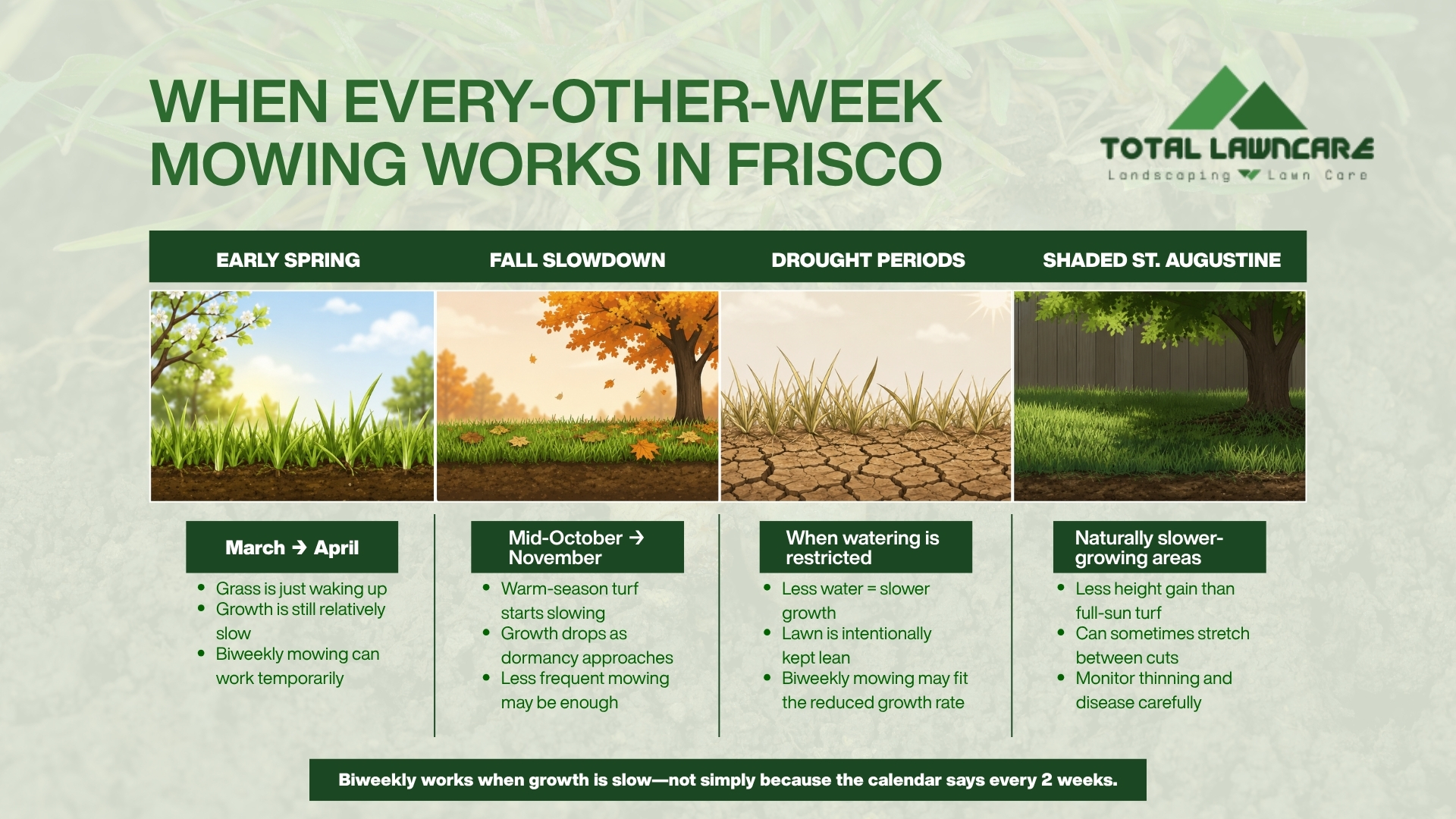
When Biweekly Mowing Actually Makes Sense In Frisco
Biweekly is not always wrong. There are real windows where it fits a Frisco lawn without breaking the one-third rule.
- Early spring (March into April), before growth fully takes off, when the grass is still waking up.
- Fall (mid-October to November) as warm-season turf slows down heading toward dormancy.
- Drought stretches with watering restrictions, when the lawn is deliberately kept lean and growth stalls.
- Shaded, slow-growing sections of St. Augustine that genuinely put on less height than a full-sun Bermuda yard.
The rule of thumb we use: if the grass is not gaining more than about a third of its height in two weeks, biweekly is safe. In a Frisco summer, that rarely holds. In the shoulder seasons, it often does. Matching the cadence to the actual growth rate, rather than a fixed budget, is how you keep the lawn healthy and your spending sensible.
Homeowners often ask whether they can just switch back and forth as needed, and the answer is yes; that is exactly what we recommend. A lawn does not care what your contract says; it cares how much you are cutting off each time. A crew that adjusts the cadence with the season, tightening to weekly when growth explodes and easing off when it slows, delivers a healthier lawn for a sensible yearly spend than any fixed schedule locked in every January.
The HOA Factor In Frisco And Its Neighborhoods
Cost and biology are not the only forces at work here. Many Frisco and surrounding North Texas HOAs enforce turf height and edging standards, and a biweekly lawn in peak growth can quietly drift out of compliance in the second week. A lawn that looked sharp on day one can be tall and shaggy by day thirteen, which is when the courtesy notice shows up.
If you live in an HOA-governed neighborhood, weekly service in summer is often the practical floor, not a luxury. Crisp weekly edging and a consistent height keep you off the violation list, and that alone tips the value math toward weekly for a lot of Frisco homeowners.
Making The Call For Your Lawn
Put the pieces together, and a simple decision guide falls out for most Frisco yards.
- Bermuda in full sun, May to September: weekly. It grows too fast for biweekly to respect the one-third rule.
- St. Augustine, summer: weekly, mostly to dodge brown patches after a skipped week.
- Any HOA lot in peak season: weekly, to stay compliant on height and edging.
- Spring and fall for most lawns: biweekly is reasonable and saves money.
- Shaded or drought-stalled turf: biweekly can hold; watch the growth rate.
The mistake we see most is locking in biweekly for the whole year to save money, then paying it back in scalped turf, brown patch repair, or an HOA notice. Flexing to weekly for the hot months and easing to biweekly in the shoulder seasons is almost always the better spend.
What to ask a lawn service before you sign
Before you commit to any cadence, ask a crew a few direct questions. Do they adjust frequency with the season or lock you into one schedule year-round? What height do they keep Bermuda versus St. Augustine, and will they bump the height up in peak heat? How do they handle an overgrown lawn without scalping it?
The answers tell you fast whether a company understands warm-season turf or is just running a mower over your yard on a fixed calendar. Our lawn care blog covers more of these local specifics if you want to read further before you decide.
Where to go from here
Weekly vs biweekly mowing in Frisco really comes down to growth rate, grass type, and whether your lawn can take a cut without breaking the one-third rule. In our summer heat, weekly usually wins for Bermuda and St. Augustine alike, while biweekly earns its place in the cooler shoulder seasons. If you want a straight answer for your specific lot, grass, and neighborhood rules, the team at Total Lawn Care DFW can walk your yard, tell you honestly which cadence fits, and set a schedule that keeps the turf healthy without overspending. Our Frisco lawn care page has the details on what a full-service visit includes.