


 Schedule Now
  (469)-221-9095
 TL;DR
Apply fall pre-emergent in North Texas when soil temperature drops to about 70 degrees Fahrenheit and remains there for 4 to 5 consecutive days, which is the germination threshold for annual bluegrass, rescuegrass, henbit, and chickweed. Miss it, and you have bought a bag of nothing.
That usually lands somewhere between mid-August and early October in Collin and Denton counties, but the actual date shifts by two or three weeks from year to year, so the temperature reading decides it, not the month. Read soil temperature yourself with a probe pushed two inches into open turf, or watch a nearby public station.
The application only works once it is watered in, so the watering plan matters as much as the timing.
The Trigger Is 70 Degrees, Held for Four to Five Days
The St. Augustinegrass maintenance calendar published by Texas A&M AgriLife Extension states it plainly. Under the September and October columns, the weed control row reads: “Apply pre-emergence herbicides when soil temperatures reach approximately 70F for 4 to 5 consecutive days for the prevention of select winter annual weeds (i.e., annual bluegrass, henbit, rescuegrass).” The St. Augustinegrass home lawn maintenance calendar from AggieTurf carries that language on a single page you can print and stick inside the garage door.
Two parts of that sentence do the work. The first is the number. The second is the phrase “four to five consecutive days,” which exists because one cool front does not change the soil. A September cold snap can drop air temperature thirty degrees in an afternoon and leave the soil at 84 degrees because soil holds heat. Waiting for the reading to stay down is what separates a real trigger from a guess.
Why 70 and not some other figure? Because the target sets it. Annual bluegrass, Poa annua, is the winter annual most North Texas homeowners are actually fighting, and it germinates as soil cools below that point. The AgriLife bermudagrass guidance describes the life cycle: winter annual weeds “germinate in late summer/early fall, grow throughout the fall and winter, and then flower, set seed and die in the spring.” The clumpy pale grass you notice in a February yard was decided in September. By the time you can see it, the pre-emergent decision is eleven months old.
The window closes; it does not narrow
A post-emergent has a bad week and a good week. A pre-emergent has an on and an off. AgriLife is blunt about the mechanism: these herbicides “are effective only if they are applied uniformly and are watered into the soil by rainfall or irrigation before the target weed emerges,” and they “will not control weeds adequately after they emerge.” There is no partial credit for being close. Seed that has already germinated is past the product entirely.
How Do You Check Soil Temperature in Plano or Allen?
Push a soil thermometer two inches into open turf, away from concrete and away from shade, read it at the same time each morning, and write the number down. Four or five days of readings around 70 and falling is your signal. A probe-type meat thermometer works. Chrissie Segars, the AgriLife Extension turfgrass specialist based in Dallas, has recommended exactly that, along with a warning worth taping to the shed: “Don’t get into the habit of relying on the same calendar date every year; that’s why we have soil temperature recommendations.”
The second option costs nothing. The Texas Water Development Board runs TexMesonet, a statewide network of weather stations that logs soil moisture and soil temperature at 5, 10, 20, and 50 centimeter depths and reports every five minutes. The nearest station to our service area is Mustang Special in Denton County, roughly 13 miles from Frisco and about 20 miles from Allen. Its shallowest probe sits at 5 centimeters, near enough to the two-inch depth where the seed is sitting.
Here is what that station was reporting at 2:55 in the morning on August 12, 2026, which is close to the daily low point for shallow soil: 32.3 degrees Celsius at 5 centimeters, or 90.2 degrees Fahrenheit. The 10-centimeter probe read 91.1. Air temperature at the same moment was 85.5.
That gap is the whole point of this article. Twenty degrees of cooling has to happen in the ground before the window opens, and shallow soil in a Collin County yard sheds heat slowly through September. Anyone telling you to spray on September 1 is not looking at a thermometer.
One caveat on borrowed data. A station in an open field on native soil is not your yard. Black clay under a south-facing Allen lawn with no tree cover runs warmer than a shaded St. Augustine yard in west Plano, sometimes by several degrees. Use the public station to see the trend and to know when to start paying attention. Use your own probe for the go decision.
Will Pre-Emergent Kill Weeds That Are Already Up?
No. A pre-emergent works on the seed as it germinates, so anything already green and growing is untouched by it. That is the whole reason timing decides the season: apply it early and the barrier is in place before the seed wakes up; apply it late, and you are paying for a product that has nothing left to prevent. Weeds already standing need a different treatment entirely.
Why the Date Moves Every Year
Two AgriLife documents give what look like two different answers, and understanding the difference is what keeps you from applying blind. The bermudagrass lawn management calendar says that for lawns with a history of winter annuals, certain pre-emergents “can be applied from mid-August to mid-September.” The St. Augustinegrass calendar gives the 70-degree trigger under September and October.
Both are right. The date range is the typical calendar equivalent of the temperature rule in an average Texas year across a very large state. The temperature rule is the rule. In a hot, dry September, the soil in Frisco can sit above 75 degrees into the first week of October. After a wet, cloudy stretch, it can pass through 70 in the third week of September. A three-week spread between two neighboring years is normal here, and every one of those weeks is a week of Poa annua germination you either prevented or did not.
There is a related rule that catches people who split their applications. Even a perfect spring pre-emergent does nothing for winter weeds. AgriLife states it directly: “Even if you apply a pre-emergence herbicide in the spring to control summer annual weeds, you must treat again in the fall to control winter annual weeds.” Spring product targets crabgrass and goosegrass and is long gone by August. They are two different jobs on two different clocks.
Watering It In Is Half the Job
Product sitting on top of the grass is not a barrier. It becomes one only after water carries it into the top layer of soil, which is why the watering plan needs to be made before the bag is opened, not after. AgriLife’s guidance for granular products is a quarter to a half inch of water applied immediately after the application, with the label taking precedence over any general figure.
A quarter inch sounds small until you try to deliver it precisely. The AgriLife bermudagrass publication describes the catch-can test, and it takes about half an hour. Set jars or straight-sided cans around the zone, run the system for a set time, then measure with a ruler. Their worked example: “If you catch 0.33 inches of water in 20 minutes, scheduling your system to run for 20 minutes 3 times per week will deliver approximately 1 inch of water per week.” Run the same arithmetic backwards, and a zone that puts out a third of an inch in twenty minutes delivers a quarter inch in about fifteen.
Now you know your run time instead of guessing at it. Guessing is what costs people the season.
Two mistakes we see repeatedly on fall applications. The first is watering too lightly, which moves the product a fraction of an inch and leaves most of it in the thatch. The second is watering far too heavily on a clay yard with any slope, which sends product down the driveway and into the gutter. Neither one leaves you with a barrier where the seed is.
Rain is not a plan
Counting on a forecast to water in a granular pre-emergent is a coin flip, and North Texas September rain tends to arrive as an inch in twenty minutes rather than a quarter inch spread out. If a genuine soaking rain lands within a day of application, take the free irrigation. Do not schedule around a chance of storms.
Plano’s Watering Rules Change the Timing
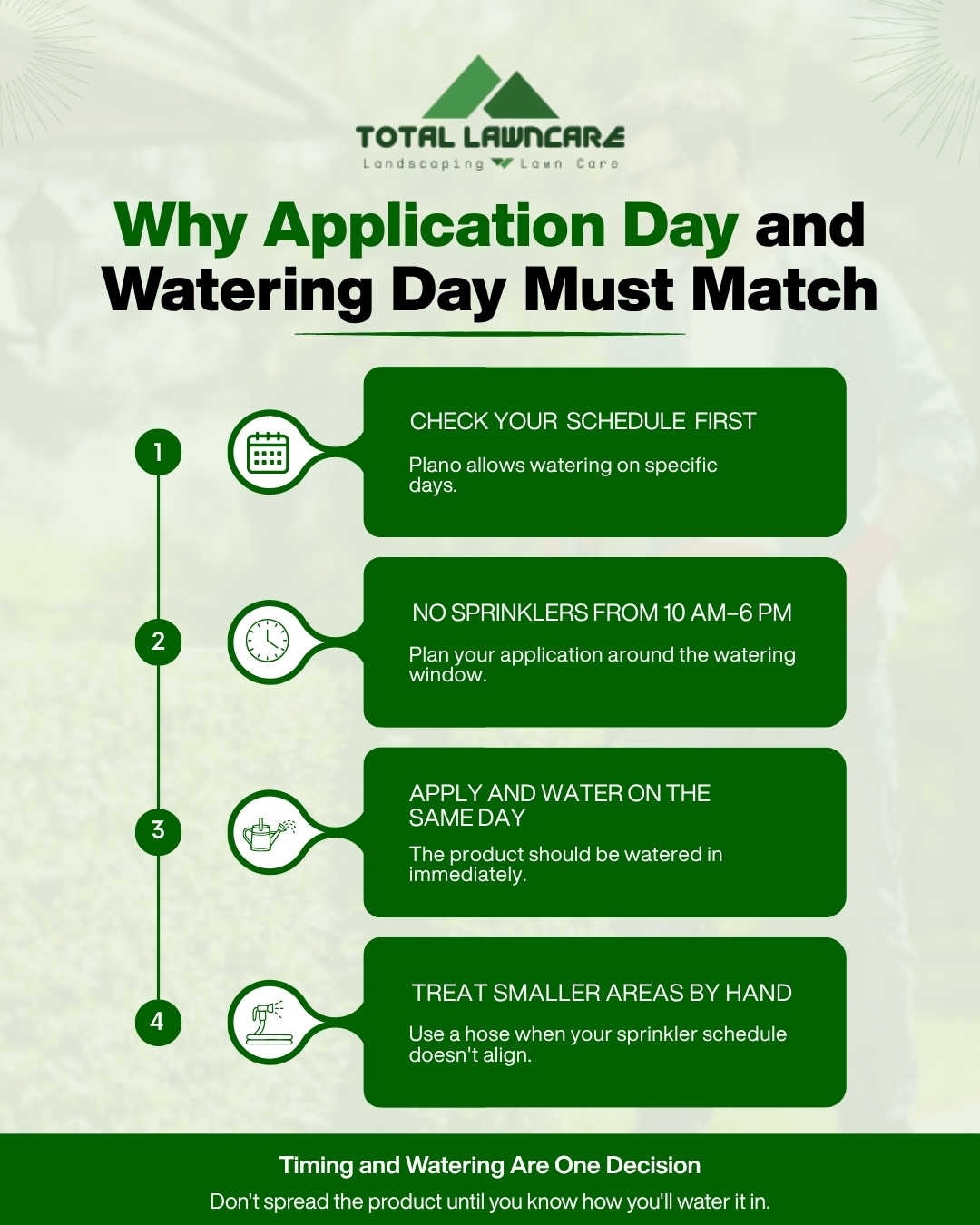
This is where the North Texas version of the job stops matching the advice on national lawn sites. The City of Plano runs a spring and summer watering schedule from April 1 through October 31, which covers the entire fall pre-emergent window. Under the schedule the city published on April 2, 2026, residents are asked to water no more than twice a week, with even-numbered addresses on Mondays and Thursdays and odd-numbered addresses on Tuesdays and Fridays. Sprinklers are not to run between 10 a.m. and 6 p.m.
Homeowners associations, common areas, and addresses ending in zero follow the even schedule.
Timing and watering are one decision, not two.
Read that against a product that has to be watered in immediately, and the conflict is obvious. Put granules down on a Wednesday at an even-numbered address and your sprinkler day is Thursday morning.
The city’s own release contains the way around it. Grass, shrubs and trees may be watered for up to two hours on any day by a hand-held hose or a soaker hose, and low-flow drip may run as needed. So the plan writes itself: match your application day to your sprinkler day where you can, and where you cannot, treat a smaller area and water it in by hose the same evening.
| Situation | What actually works |
| Even address, sprinkler days Monday and Thursday | Apply Sunday evening or early Monday, irrigate on the Monday cycle before 10 a.m. |
| Odd address, sprinkler days Tuesday and Friday | Apply Monday evening or early Tuesday; irrigate on the Tuesday cycle |
| Application day cannot be moved | Do one zone at a time and water in with a hand-held or soaker hose, allowed any day |
| Beds and narrow strips on drip | Drip may run as needed, so these are the easiest areas to time |
| Rain arriving within 24 hours | Take it if it is a real soaking, and skip watering during rain and runoff |
Frisco, Allen, and the other North Texas Municipal Water District cities run their own versions of this schedule, so check your own city before you plan the day. The principle does not change: the assigned day, not the soil thermometer, is often the thing that decides your application date, and knowing that a week ahead is the difference between hitting the window and missing it.
What Happens If You Miss the Window?
You spend the next six months on post-emergent control, and your options get worse. Once annual bluegrass has emerged, pre-emergent chemistry is irrelevant to those plants. The remaining choices are post-emergent products applied to actively growing weeds, spot treatment, and patience, all through a season when the turf around them is going dormant and cannot outcompete anything.
There is a second cost that shows up much later. Each Poa annua plant that survives the winter flowers and sets seed in the spring before it dies, which loads the seed bank for next fall. One missed application is not one bad winter. It raises the pressure on every application after it, which is why the yards that look clean in February are usually the yards that have been treated on time for several years running, not the ones that got a rescue spray in January.
If your yard is already past the window this year, the honest advice is to stop chasing it, mow if needed to keep winter annuals from flowering, and mark the calendar to start taking soil temperature readings in mid-August next year. That is also the point where handing the timing to someone who is already watching the numbers pays for itself, and it is most of why homeowners call us about lawn treatment service Allen yards need rather than adding one more thing to track.
Choosing a Product and Reading the Label
Ignore the bag art.
The active ingredient matters more than the brand on the front of the bag. AgriLife’s table of pre-emergence herbicides for warm-season lawns lists prodiamine, pendimethalin, dithiopyr, isoxaben, and corn gluten meal, with notes that save money and prevent mistakes.
- Prodiamine and pendimethalin both control grasses and some broadleaf weeds, and both may stain concrete and brick pavers, so sweep hardscapes immediately after applying.
- Isoxaben handles broadleaf weeds and, in AgriLife’s words, “will not control grassy weeds such as crabgrass or annual bluegrass.” A broadleaf-only product is the wrong tool if Poa annua is your problem.
- Corn gluten meal is the organic option and, in the same table, “may not be as effective as options listed below.”
- On a granular carrier, choose one with little or no nitrogen. Nitrogen belongs on green, actively growing bermudagrass, and AgriLife notes that over-irrigation and early fall nitrogen both increase the incidence and severity of large patch disease.
- If you plan to overseed with ryegrass this fall, do not apply a pre-emergent at all. It cannot tell your seed from theirs.
Then read the label, and treat the rate on it as fixed. The EPA is explicit that a pesticide label is legally enforceable and that every label carries the line “It is a violation of Federal law to use this product in a manner inconsistent with its labeling.” The label defines, in the EPA’s own words, “who may use a pesticide, as well as where, how, how much, and how often it may be used.” Their introduction to pesticide labels is worth five minutes before your first application.
More is not better here.
Doubling the rate does not double the barrier. It risks turf injury, and it is against federal law. The rate is set by data the manufacturer submitted and the agency reviewed.
The Rest of the North Texas Fall Calendar
One reading decides the whole season.
Pre-emergent timing sits inside a short run of decisions that all key off the same cooling curve, and a couple of them are easy to get backwards.
Nitrogen has a hard stop. AgriLife’s calendars say to make the last nitrogen application four to six weeks before the first historic frost. The National Weather Service office in Fort Worth puts the average date of the first freeze at DFW Airport at November 22, based on records back to 1898, with the earliest freeze on record on October 22, 1898. Count back, and the last safe nitrogen for a Plano or Allen yard lands somewhere in mid-October. Feed a bermudagrass lawn in November, and you are pushing tender growth into a freeze.
Large patch runs on the same thermometer you are already reading. The St. Augustinegrass calendar puts preventative fungicide, in yards with a history of the disease, at soil temperatures between 50 and 70 degrees. The upper end of that range is the same number that triggers your pre-emergent, so one probe reading informs two decisions in the same week.
Mowing height holds until dormancy. AgriLife’s recommended range is 1 to 2 inches for bermudagrass home lawns and 2 to 4 inches for St. Augustinegrass, and taller settings within the range reduce weed pressure on their own. Cutting a St. Augustine yard short going into fall is an invitation to every winter annual in the seed bank.
Leaf litter is the last piece, and it is not cosmetic to us.
A mat of leaves left over on damp turf through a mild North Texas winter traps moisture against the crown. Getting fall leaf and bed cleanup done before the first hard freeze is worth more than most of the products people buy in November. The same logic drives why a weekly visit keeps a Dallas yard looking sharp through the shoulder seasons: somebody is looking at the yard often enough to notice what changed.
Watch the Soil, Not the Calendar, This Pre-Emergent Season
Start reading soil temperature in mid-August. Buy a probe or bookmark the nearest public station, take a reading at the same time each morning, and watch for four or five consecutive days near 70 and trending down. Check your city’s watering day now, before the reading arrives, and decide now: sprinkler day, or hose. Choose a grass-active product with little or no nitrogen, apply at the label rate, and water in a quarter to a half inch immediately.
If that is more tracking than you want to do in a busy September, we already run this schedule across our Plano routes, the Frisco yards we service each week, and the HOA common areas and commercial properties we maintain across Collin County. Tell us your address and grass type, and Total Lawn Care DFW will put your yard on the fall list or get a quote for your yard, and we will build the timing around your watering day.