


 Schedule Now
  (469)-221-9095
 A dormant warm-season lawn in North Texas is not a lawn that needs nothing until spring. It needs less, and it needs different things, and the one job most people skip entirely is watering it during a warm, dry, windy stretch in January. The brown is normal. The neglect is what causes the patchy green-up in April that nobody can explain.
TL;DR
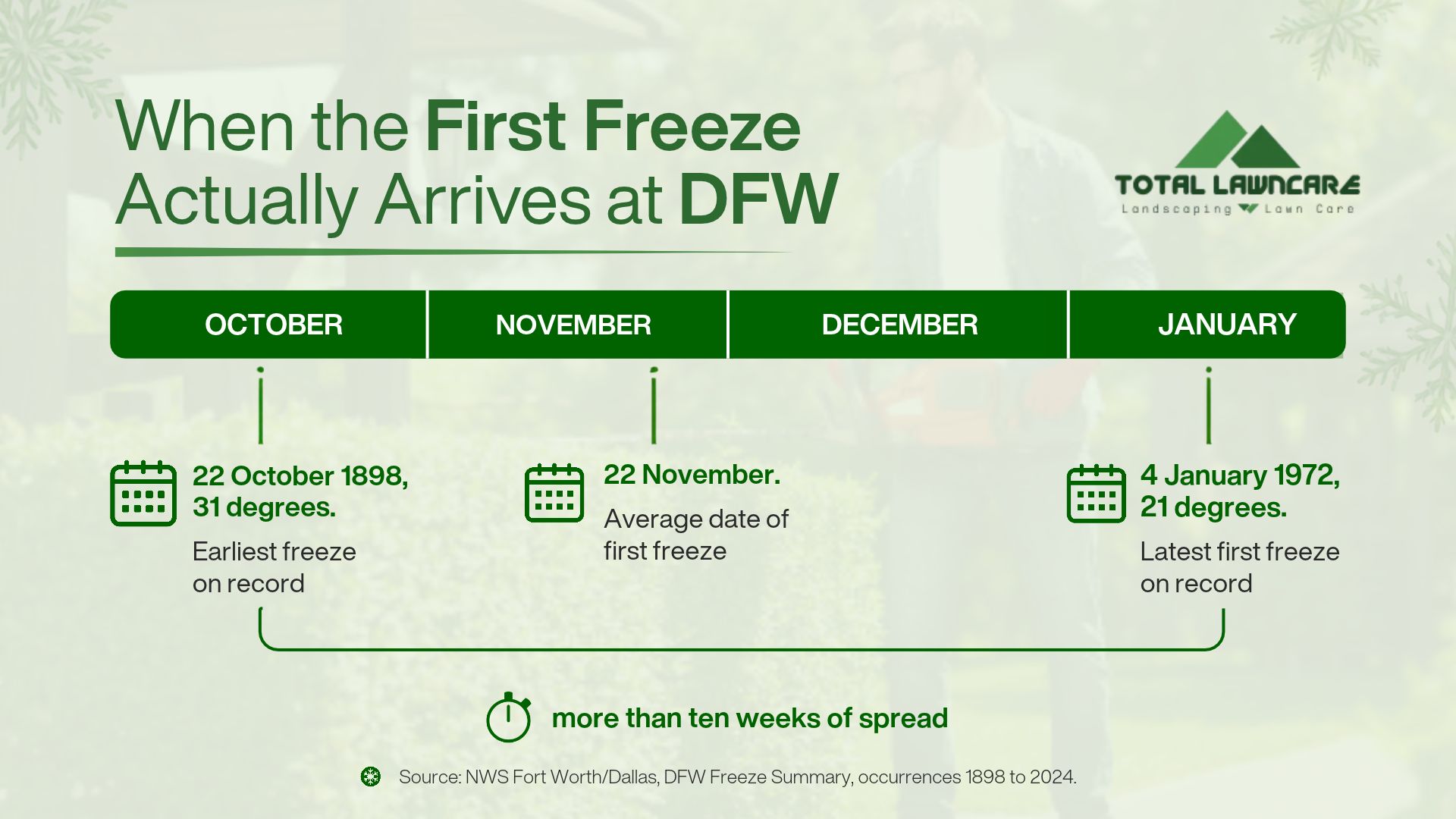
Bermuda and zoysia go dormant after the first hard freeze and stay brown until soil temperatures come back up. Through that window, the state’s own turf guidance says to keep mowing only until the grass stops needing it, not to fertilise unless the lawn has been overseeded, to treat winter annual broadleaf weeds as they appear, and to water periodically if the weather turns warm, dry and windy. DFW averages its first freeze on 22 November, but the recorded range runs from 22 October to 4 January, so plan against the range rather than the average.
When Does the Lawn Actually Stop?
The honest answer is that the date moves by weeks, and planning against the average is how people get caught out.
The National Weather Service office for Fort Worth and Dallas keeps a freeze summary for DFW that runs from 1898 through the winter of 2023 to 2024. Its headline numbers are worth committing to memory if you own a lawn here.
The average date of first freeze is 22 November. The average date of last freeze is 12 March. So the dormant window averages a little under four months.
Now the range, which is the part that matters. The earliest freeze in the record is 22 October 1898, at 31 degrees. The latest first freeze is 4 January 1972, at 21 degrees. That is a spread of more than ten weeks in when the season actually starts.
Why the average is the wrong planning number
A lawn does not experience an average. It experiences one particular autumn.
If you schedule the last mow for the week of the average first freeze and the freeze arrives on 1 November, the grass went into dormancy taller than intended. If the freeze holds off until late December, a lawn treated as finished in November has had six more weeks of growth nobody managed.
The useful habit is to watch the grass rather than the calendar, which is also what the state guidance says to do.
What the State’s Turf Guidance Says for This Window
Texas A&M AgriLife Extension publishes a maintenance calendar for bermudagrass lawns, and it treats September through February as one block. Four instructions come out of it, and they are short.
On mowing, the AgriLife bermudagrass calendar says to continue the recommended mowing practices until the grass goes dormant and does not require mowing. An overseeded lawn, planted with a cool-season grass to hold colour, needs mowing throughout the winter instead.
On feeding, the instruction is blunt: do not fertilise bermudagrass unless the lawn has been overseeded. Where a lawn has been overseeded, the guidance is one feed in December and another in February, at half a pound of nitrogen per 1,000 square feet, using a nitrogen-only product.
On watering, and this is the line nobody reads: you may need to water dormant bermudagrass periodically if the weather is warm, dry, and windy.
On pests and weeds, apply postemergent herbicides as needed to control winter annual broadleaf weeds, and expect no detrimental insect activity over winter.
Does a Brown Lawn Really Need Water?
Yes, in the conditions the guidance names, and this is the single most useful thing in this article.
Dormancy is not death, and it is not a sealed state either. The crown and the root system are alive underneath, and they lose moisture. A North Texas winter regularly delivers exactly the combination the guidance warns about: a run of mild days, no rain for weeks, and the wind that comes with a dry frontal pattern.
Under those conditions, a dormant lawn can desiccate. What you see in spring is not an immediate brown patch, because the lawn is already brown. What you see is thin, slow, uneven green-up in April, on the exposed parts of the yard first, and it gets blamed on grubs or on the previous summer.
How to think about it
Rain does the job most winters here. The point is to notice the winters when it does not.
Three or four weeks of no measurable rain, daytime temperatures well above average, and persistent wind is the pattern to act on. A single deep watering during a mild spell, not a return to a summer schedule, is what the guidance describes as periodic.
Then stop. Watering a dormant lawn on a schedule it does not need wastes water, and in our soils it does nothing good. The reason our clay behaves the way it does is covered in our notes on Dallas soil types, and it applies in winter as much as in July.
What About the Grass That Is Still Green?
The green things in a dormant lawn in January are usually not your lawn.
Winter annual broadleaf weeds germinate in autumn, grow through the cool months, and are conspicuous precisely because everything around them has shut down. They are the reason a dormant lawn can look worse in February than it did in December, and they are why the AgriLife calendar includes postemergent treatment in this window.
There is an important distinction to keep straight, though, and it decides which product does anything.
Preventing next season’s weeds is a different job with different timing, and it belongs to a pre-emergent applied before germination rather than to anything sprayed in January. We covered that separately in when to apply pre-emergent, and it is worth reading alongside this rather than instead of it, because the two jobs sit either side of the same season.
Plan for the Outlier, Not the Average
Two federal datasets say the same thing from different directions, and together they are the argument for how to treat a North Texas winter.
The USDA revised its Plant Hardiness Zone Map in 2023, and its own explanation of what a zone means is carefully worded. Zone designations represent the average annual extreme minimum temperature at a location over thirty years. The agency then adds the caveat that matters: the designations do not reflect the coldest it has ever been or ever will be at a specific location, but simply the average lowest winter temperature over that period.USDA Unveils Updated Plant Hardiness Zone Map
Comparing the 2023 map with the 2012 version, about half the country shifted to the next warmer half zone, which corresponds to warming somewhere in the range of zero to five degrees Fahrenheit.
Set that beside the local record. The DFW freeze summary records the longest run below freezing as 295 consecutive hours, from seven in the morning on 18 December through two in the afternoon on 30 December 1983. February 2021 produced 139 consecutive hours, with a further 93 hours after a brief climb above freezing, for 232 nonconsecutive hours.
A warming average and a record of severe outliers are not in conflict. They are the same message: the typical winter is getting slightly milder, and the winter that does the damage is not the typical one.
What that means practically
It means the irrigation system, not the grass, is the thing to worry about in a hard freeze. Turf that goes into winter healthy tolerates cold far better than exposed pipework, backflow devices, and above-ground valves, and those are what fail during a run of hours below freezing rather than a single cold night.
It also means the plan should not assume the mild version. Preparing for a hard freeze costs an afternoon in November. Not preparing costs whatever broke.
What Happens Underground While Nothing Happens Above It
The part of the lawn that decides how April goes is the part nobody looks at between November and March.
Above the surface, a dormant warm-season lawn has stopped. The leaf blades are not photosynthesising, the colour has gone, and the grass is not producing new top growth. Below the surface, it is a different picture. The crown, the growing point at the base of each plant, is alive and holding the reserves the lawn will spend on green-up. The root system is still there, still in contact with soil moisture, and still losing water to the air through the soil profile above it.
This is why the two failure modes of a North Texas winter look nothing like each other.
The first is desiccation, which is slow and invisible and shows up months later as patchy green-up. The second is cold injury, which is rare here on established warm-season turf and tends to hit the newest and most exposed plantings rather than an established lawn.
Almost everything a homeowner can do about either one happens before the cold rather than during it.
Traffic on dormant turf
One more thing worth knowing, because it is easy to avoid and impossible to undo.
Dormant grass does not repair itself. A path worn across the lawn in December is not going to grow out in January, because nothing is growing. It sits there until green-up, and where the wear was heavy enough to damage crowns, it does not fully recover then either.
That covers the obvious cases, like parking a trailer on the grass over the holidays, and the less obvious ones, like the route everyone takes to the bins. On a dormant lawn, a repeated path compacts soil that is often already heavy clay, and compaction is a much bigger job to fix in spring than a diverted route was to arrange in November.
The Irrigation System Is the Real Winter Job
If there is one afternoon of actual work in the dormant months, this is it, and it has nothing to do with the grass.
A run of hours below freezing is what breaks irrigation components, and the DFW record shows those runs are long enough to reach things that a single frosty night never would. Backflow prevention assemblies sit above ground by design, because they have to be testable. Exposed valves, pressure vacuum breakers, and any pipework that rises out of the soil are all in the same position.
The order of work is unglamorous and short. Shut the system down at the isolation valve. Drain what can be drained. Insulate what stays exposed, and check that the insulation is still there in January rather than assuming it survived the first storm. Then leave the controller off, because a system that runs on a schedule through a freeze can do damage a dormant lawn never needed in the first place.
A Short List for the Dormant Months
Nothing here is weekly work. Most of it is a few decisions made once.
- Keep mowing until the grass genuinely stops growing, rather than stopping on a date
- Leave feeding alone unless the lawn has been overseeded, in which case follow the December and February schedule
- Watch for a dry, mild, windy run of three or four weeks and water once, deeply, if one arrives
- Treat winter annual broadleaf weeds when you see them, and keep that separate from pre-emergent timing
- Keep leaves off the turf, because a mat of wet leaves over dormant grass holds moisture against the crown
- Protect the irrigation system before the first hard freeze rather than after the forecast changes
Point five is the one that catches people who moved here from further north, where leaving a leaf layer over the winter is common advice. On a dormant warm-season lawn in North Texas, it is a way to arrive at spring with dead patches shaped like the places the leaves piled up.
Get the Winter Right, and April Looks After Itself
A dormant lawn asks very little, which is exactly why it gets forgotten. The work that shows up in April is not spring work. It is the watering nobody did in a dry January and the mowing that stopped three weeks too early.
Total Lawn Care DFW works through the dormant months as well as the growing ones, and a full service lawn plan covers the winter jobs that are easy to miss precisely because there is nothing obviously growing. If your lawn came out of last spring patchy and nobody could say why, the answer is usually somewhere in the four months before it.